
Our school community
Wrenvale College
Belong · Learn · Flourish
Recognising harmful conduct: teachers and bullying
WHAT?
What do we mean by workplace bullying?
Bullying involves harmful behaviour and difficulty defending oneself, often within unequal social or organisational power. A teacher’s formal classroom authority does not guarantee protection from coordinated targeting or exclusion (Kauppi & Pörhölä, 2012). Workplace bullying involves unreasonable behaviour towards a worker or group that creates a health and safety risk. It is most commonly recognised over repeated events, but a single harmful incident still deserves attention. Reasonable management action conducted reasonably is excluded from the workplace bullying definition (WorkSafe Queensland, n.d.). Respectful disagreement and evidence-based feedback are legitimate parts of professional practice.
Cyberbullying uses digital communication to target, intimidate or humiliate someone. Reposting, impersonation and continuing availability can extend exposure beyond the original interaction (Coyne et al., 2017). Cyberbullying differs from in-person bullying because it can extend beyond school hours and physical settings, reach a wide audience rapidly, and persist through repeated sharing or ongoing access to harmful content.
What can it look like at school? Some examples:
Colleague examples: A teacher is repeatedly excluded from planning, denied shared resources and mocked for asking questions. Another example could include a group of staff repeatedly leaves a teacher out of staffroom conversations, shares disparaging jokes about them and encourages others to avoid working with them
Parent examples: Repeated insulting email and demanding contact outside agreed channels. A parent repeatedly makes personal attacks on a teacher in a parent group chat and encourages other families to join in mocking or discrediting them.
Student examples: Students may bully a teacher through repeated personal insults, mocking their appearance or mannerisms, spreading rumours, or coordinating classroom behaviour intended to humiliate or intimidate them.
Why teacher workplace bullying needs attention
Workforce retention concerns have brought teachers’ working conditions into focus (Longmuir et al., 2025). In terms of prevalence, Australian research indicates that bullying is a substantial concern across education settings: 24.6% of 591 early childhood professionals reported workplace bullying, most commonly by co-workers (McFarland et al., 2024). An earlier exploratory survey of 560 Australian teaching professionals found that 80% reported some form of student- or parent-led bullying or harassment during the preceding 9–12 months (Billett et al., 2019). These figures are not directly comparable as national prevalence estimates, but highlight the importance of addressing harmful behaviour from both within and beyond the staff team.
Intimidation, humiliation and isolation can appear in both workplace bullying and intimate partner violence. Comparing behaviours helps explain barriers to seeking support without equating the relationships or their legal and safety responses (Verkuil et al., 2015; Wathen et al., 2015). The table below summarises this comparison:
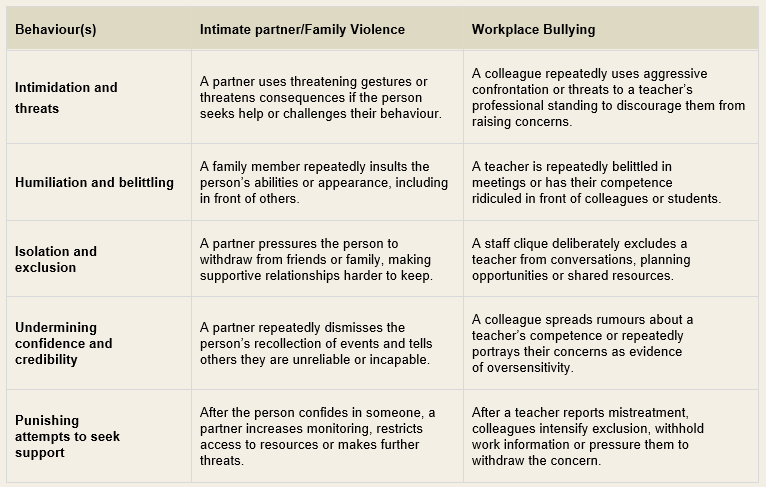
These illustrative examples show potentially similar patterns across different contexts. They do not imply that the behaviours, power dynamics, severity or safety implications are equivalent.
When bullying and abuse travels online
Online targeting may reach teachers after work and circulate beyond their school community. Impersonation can undermine control over professional identity and increase powerlessness of the teacher. Rage-bait content deliberately provokes anger to increase online attention and engagement (Oxford University Press, 2025). Generative AI can fabricate apparent speech, images or behaviour (eSafety Commissioner, 2026b). The persistence and reach of online abuse can make it difficult for teachers to gain respite from being targeted, with cyberbullying associated with psychological exhaustion and poorer wellbeing (Varela et al., 2025). Cyberbullying may also undermine teachers’ confidence in their professional effectiveness by increasing self-doubt about their competence and judgement (Moon et al., 2026), while its visibility across the school community may place wider staff morale under strain as colleagues witness the targeting of a fellow teacher (Nielsen et al., 2024)
Four online examples
AI image abuse targeting a teacher
ABC reported a Melbourne student’s expulsion after a fabricated sexual image of a female teacher was created and circulated. The report illustrates image-based abuse, without reproducing the image.
A teacher’s stolen identity
ABC described the harm to a teacher whose identity an adult offender used to groom a child. This illustrates identity misuse and reputational harm.
School-targeting accounts
eSafety describes reports of anonymous accounts using staff images, AI manipulation and fabricated stories. This is a national pattern of reported harm, not a prevalence estimate or a single case.
Impersonation accounts
Great Valley students impersonated teachers on TikTok.

